
I have been reading and re-reading Psalm 139 and 147. They create a unique bi-focal lens through which I’m learning to reframe my view of the world. One Psalm reinforces the grandeur and greatness of God-while pointing to His providential care, the other testifies of an intensely intimate knowledge that defies human comprehension.
“The LORD …heals the brokenhearted
and binds up their wounds.
He determines the number of the stars;
He gives to all of them their names.
Great is our Lord, and abundant in power;
His understanding is beyond measure.
The LORD lifts up the humble...”
Centered between the bookends of God caring for the outcast, and lifting up the humble and brokenhearted is the proclamation of his greatness and might. As evidenced in the glory of the universe on display in the sky above us, the multitude of stars, each which He knows by name.
Then, in Psalm 139, the focus of God’s majestic power takes an intimately inner focus:
“For you formed my inward parts;
you knitted me together in my mother’s womb.
I praise you, for I am fearfully and wonderfully made.
Wonderful are your works;
my soul knows it very well.”

We recently visited Southeast Utah and were blessed with a clear night sky one night overlooking Canyonlands. We had never seen so many stars. And the Milky Way was visible with the naked eye. It was breathtaking. No wonder the Psalmist wrote “The heavens declare the glory of God, and the sky above proclaims his handiwork.”
In our suffering and feelings of humility and isolation, what we often need are moments of wonder. A gaze at this sky above us to remind ourselves who is in charge, how vast is his power and wonder, and how fearfully and wonderfully we are made - each one of us by hand, known even more intimately than any of those billions of stars and galaxies.
However, I was recently reflecting on all of this and realized these two Psalms don’t simply invite me to refocus my understanding of God’s greatness and His caring regard for me as an individual. They also invite me to re-evaluate how I perceive and regard others! When I experience other people, whether strangers, loved ones, coworkers, or neighbors, am I regarding them with the same kind of wonder, dignity, and artistic appreciation as God seems to behold me?
I recently read some interesting data on the human brain:
“The human brain consists of 100 billion neurons and over 100 trillion synaptic connections. There are more neurons in a single human brain than stars in the milky way!” (https://medicine.yale.edu/lab/colon-ramos/overview/)
“Many of us have seen microscopic images of neurons in the brain — each neuron appearing as a glowing cell in a vast sea of blackness. This image is misleading: Neurons don’t exist in isolation. In the human brain, some 86 billion neurons form 100 trillion connections to each other — numbers that, ironically, are far too large for the human brain to fathom.” (https://hms.harvard.edu/news/new-field-neuroscience-aims-map-connections-brain)
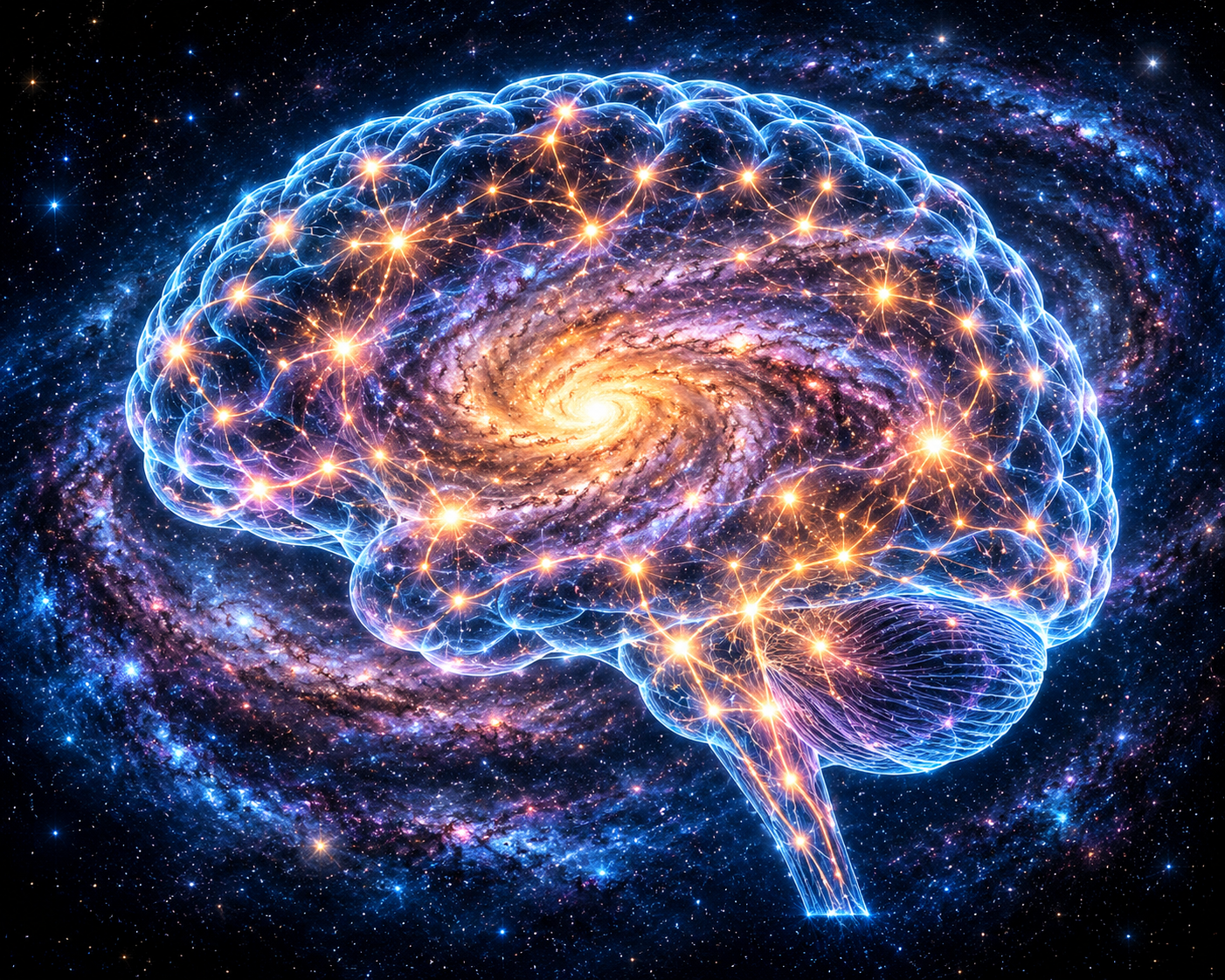
(image 100% AI generated by Open AI)
Many of us as caregivers see the results of a deteriorating or damaged brain. We see what happens when synapses fail and unhealthy proteins form. We may see MRI images that give us a glimpse of white spots that signal broken thinking, but we can’t truly see what’s happening at the neuro-microscopic level. It’s tempting to think of the people we care for as having a “broken brain”, but have you stopped to think about how complex, mysterious and unfathomable the human brain actually is?
Have you stopped to consider and identify that the broken brain you are observing is a complex system of neurons and neural pathways that is more vast than the stars in the Milky Way galaxy! And have you stopped to consider that there is a Creator behind that Who, just as He threw the stars into existence and knows each one by name, surely also knows the name of each neuron in your loved one’s brain, and in yours as well!
Despite the brokenness and corruption that is there (as with every single one of us!), there is infinite beauty in the unique masterpiece that is that “other” person you are perceiving. We may feel that what we experience mostly is the “broken” side of that person, with their projected anxieties, confusion, and anger. And yes, it’s very hard to see beyond that, trust me. But the more we train ourselves to pick up the duo-focused Jesus lenses of Psalm 139 and Psalm 147, we begin to not only behold the seemingly hidden beauty of the other, but we begin to experience them differently as well.
A final reflection that came to me in all of this was that if we are fearfully and wonderfully made, the One who made us is Himself Fearsome and Wonderful. And if in my work of caregiving for a loved one who is fearfully and wonderfully made, by me honoring and acknowledging the wonder and sacredness of that soul, I am also glorifying their Creator, the Fearsome and Wonderful One. What a profound privilege.
A final powerful example of this playing out in the life and ministry of Jesus is in Luke 5:12-13. Two short verses convey a life-altering reality about Jesus:
“While he was in one of the cities, there came a man full of leprosy. And when he saw Jesus, he fell on his face and begged him, ‘Lord, if you will, you can make me clean.’ And Jesus stretched out his hand and touched him, saying, ‘I will; be clean.’ And immediately the leprosy left him.”
I don’t need to go into a historical or clinical description of leprosy here. We likely all know what a terrible, debilitating, and life-ending disease this was, especially in that context. And to add insult to injury, if you had leprosy, you were permanently viewed as “unclean”. Your dignity and worth were destroyed. Your image presented to the world, marred beyond restoration. Jesus didn’t disregard. Jesus didn’t recoil. Jesus didn’t pity with hidden disgust. Jesus wasn’t angered by the proximity. He simply responded lovingly “I will”... with a physical touch. Jesus saw the infinite beauty of His creation in that man, and the special purpose and dignity with which he was imagined in the artist mind of God. And He treated him accordingly.
You can draw your own conclusions and parallels to your own situations. Believe me, I am convicted. My prayer for all of us is that as we cry out to Him for a renewed vision of ourselves and an elevated regard of others - through the lens of His perspective, we would be transformed in grace, love, mercy, and joyful wonder.
“…Let the words of my mouth and the meditation of my heart be acceptable in your sight, O Lord, my rock and my redeemer.” (Psalm 19)